Rise Magazine

Rise magazine is written by parents who have faced the child welfare system in their own lives. Many people don’t know that the majority of children who enter foster care return home to their parents–and that most children in care wish for a lifelong relationship with their parents, whether they live with them or not. Helping parents is fundamental to helping children in foster care.

Through personal essays and reporting, parents illuminate every aspect of the child welfare experience from parents’ perspectives. For professionals, Rise stories offer insight that can improve how you engage and support families. For parents, Rise offers information, peer support, and hope.

Rise Magazine

‘Our First Priority Is Making Sure People Are OK’

Fear of the family policing system can prevent families from accessing needed resources and support. Through community-led mutual aid, community members support each other, often responding more quickly than systems and without intrusive processes or the threat of a report to ACS for not having food or resources for your family.

Here, Kelvin Taitt, co-founder of East Brooklyn Mutual Aid and a community organizer in the Ocean Hill and Brownsville areas of Brooklyn, New York, discusses how mutual aid is different from services through the system, building relationships, keeping resources in the community and supporting investment in Black-owned businesses.

News

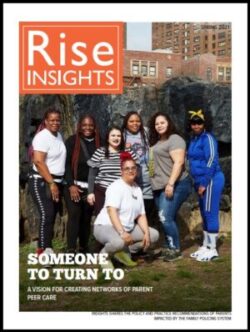
Someone To Turn To: A Vision for Creating Networks of Parent Peer Care

This Insights paper presents Rise’s vision for a peer network of collective care by and for parents. This fall, Rise created a parent Peer Vision Team to explore building a peer care model that can strengthen families while reducing contact with the family policing system.

Nationwide and in New York City, where Rise is based, it’s crucial to broadly reorganize supports for families so that accessing resources and services does not put parents at risk of state intervention in their families. Government dollars should target community conditions, not families. This report shares a vision for one critical component of strong communities: networks of peer support and community care.

Rise Magazine

Why We’re Using the Term ‘Family Policing System’

Rise is using the term ‘family policing system’ instead of ‘child welfare system’ because our team believes that it most accurately and directly describes the system’s purpose and impact. While Rise has often also used the term “family regulation system”, the Rise staff led by parents who have experienced the system considered this term “too soft” in describing the harmful role of the system in the lives of families it impacts. “Family policing” highlights the system’s connection to and similarities with the criminal justice system, and also explicitly links our work to broader movements to abolish policing.

Rise Magazine

Targeted by Two Systems: ‘I couldn’t focus only on how devastating it was for my child to be hurt and to lose my mother. I also had to worry about ACS.’

March 26, 2019 was a day I’ll never forget.

Early that morning, I got a phone call from my sister that our mom was put on life support.

I was a block away at a different hospital dealing with another emergency. A CT scan confirmed that Miles had a potential fracture in his wrist as well as a broken leg. I felt heartbroken and confused.

I couldn’t accompany him to his X-ray or visit my mother. Instead, I had to meet with an abuse doctor and Special Victims Unit detectives.

A week after the X-ray, we had a Child Safety Conference with ACS. Everything neutral was made into a negative.

Around the same time, there was a story in the news about a white actress, Jenny Mollen. She had dropped her son and he fractured his skull. She talked openly about how hard it was for her as a mother and that she was so thankful for the hospital staff. They didn’t question her motives.

Our babies were both hurt unintentionally – but we were treated very differently.

Translate »